Does Renters Insurance Cover Gifts Stolen From a Car Before I Bring Them Home?
By ChaCha InsurancePublished 9 min read
Most of the time, yes. Renters insurance policy covers gifts stolen from your car through its off-premises personal property coverage. That coverage is capped, you pay a deductible first, and it's a separate claim from any damage to the car itself.
On this page (11 sections)
Three things decide how much you get back: your off-premises limit, your deductible, and whether you can prove what was stolen. Gifts aren't treated differently from anything else you own. Until you hand them over, they're your belongings.
Does Renters or Car Insurance Pay for Gifts Stolen From Your Car?
Two policies are usually involved after a break-in, and each covers different things.
| What was lost | Which policy usually responds |
| Stolen gifts, bags, laptops, other items inside the car | Renters insurance (personal property, off-premises) |
| Smashed window or broken lock | Auto insurance (comprehensive coverage) |
| Factory-installed stereo or GPS | Auto insurance |
| The car itself, if stolen | Auto insurance (comprehensive coverage) |
These are two separate claims on two separate policies, and each has its own deductible. Details vary by insurer, so treat this as the general pattern, not a promise.
How renters insurance covers belongings stolen from a car
Your renters policy protects your belongings at home, and it also follows them. When something you own is stolen away from your apartment, insurers call that off-premises coverage. It applies in places like:
- A parking lot at work
- A mall or grocery store lot
- A friend's driveway
- A hotel garage
- A street spot outside your building
Here's the catch. Many policies cap off-premises theft at about 10% of your total personal property limit. If you carry $30,000 in personal property coverage, that could mean roughly $3,000 for things stolen away from home. Some insurers use a flat dollar cap instead of a percentage, so the only way to know your number is to look at your policy's declarations page. That's the summary page with your coverage limits and deductible.
Where the car is parked can matter too, especially if you are splitting time between two apartments during overlapping leases. A garage at your own address is often treated as part of your home, so the off-premises cap may not apply. A car parked on the street usually falls under the lower off-premises limit. Policies differ, so ask your insurer how they treat your parking situation.
One thing renters often miss is how quickly holiday shopping adds up. A few electronics and a couple of nice gifts can reach a 10% cap faster than people expect.
Are gifts you haven't given yet still your property?
Yes. Insurance covers things you own, and a gift you've bought but not yet handed over is still yours. The store receipt has your name on it, and you paid for it. That's why gifts in the back seat are generally treated like any other belongings in the car.
A few situations work differently:
- Gifts you've already given. Once someone has received a gift, it belongs to them. If it's stolen later, it would fall under their policy, if they have one.
- Gift cards and cash. Many policies exclude these or limit them tightly. If you're carrying a stack of gift cards, call your insurer before you count on them being covered.
- Items bought for a business. If you bought something for your job, your side business, or to resell, renters insurance often excludes it or applies a much lower limit, so you would need a separate small business insurance policy.
- Roommates. A renters policy usually covers the people named on it. If a roommate's gifts were in your car, they may need their own policy, or you may need to add them to yours.
Renters insurance vs. auto insurance: matching each loss to the right policy
It's easy to assume one policy covers everything in a break-in. In practice, your auto policy and your renters policy each handle a different piece.
Comprehensive auto coverage can pay for damage to the car, such as a smashed window or a broken lock. It generally doesn't pay for personal items stolen from inside the car. Most insurers say this plainly: auto insurance protects the vehicle, not the stuff in it.
Your personal belongings, like gifts, a laptop, or a bag, fall under personal property coverage, up to your off-premises limit and after your deductible.
Here's how a typical break-in might split up:
- Smashed window: auto insurance, if you carry comprehensive coverage.
- Stolen gifts: renters insurance.
- Stolen aftermarket speaker you installed yourself: often renters insurance, since it wasn't part of the car when it was built.
- Stolen factory stereo or built-in GPS: usually auto insurance, since it's part of the vehicle.
Aftermarket versus factory-installed trips people up a lot. If you're not sure how your policy classifies something, ask before you file.
Also check the repair cost against your deductible. Say the window repair is $380 and you chose a comprehensive deductible. Even at $500, there's nothing to claim on the auto side, because the repair is below what you'd pay yourself. The same logic applies to stolen items under your renters deductible.
If both policies apply, file with each insurer separately and keep the two claim numbers straight.
Off-premises limits and deductibles: a worked example
Numbers make this easier to see. This example is for illustration only. It isn't a quote, and your policy may work differently.
The setup:
- Personal property limit: $30,000
- Off-premises cap: 10%, or $3,000
- Renters deductible: $500
- Stolen gifts total: $3,284 (the sample list is in the next section)
Insurers don't all calculate the payout the same way, so here are two common approaches.
If the deductible comes off the loss first: $3,284 − $500 = $2,784. That's under the $3,000 cap, so the payout would be $2,784.
If the cap is applied first: $3,000 cap − $500 deductible = $2,500.
Same theft, same policy limits, and a difference of $284 depending on the order. Ask your insurer which method they use.
Two more things can change the number:
- Actual cash value vs. replacement cost. Actual cash value subtracts depreciation, so a two-year-old tablet pays less than a new one costs. Replacement cost pays closer to what it costs to buy a new one. Your policy states which you have.
- Per-item limits. Jewelry, watches, and sometimes electronics can have their own theft limits that are lower than the overall cap.
Check these three numbers before you shop:
- Your off-premises limit
- Your deductible
- Whether you have actual cash value or replacement cost coverage
Proof of ownership: a receipt inventory example
If something is stolen, your insurer will want proof that you owned it and what it was worth. The stronger your records, the smoother the claim. Good proof includes receipts, order confirmations, photos, and serial numbers.
If you don't have a paper receipt, you still have options:
- Bank or credit card statements showing the purchase
- Order confirmation emails
- Your order history in the store's app or website account
- Photos of the item or its box
Here's a sample gift list you can copy. Every figure is made up:
| Item | Recipient | Store | Date | Price | Proof |
| Gaming console | Teen | Retailer A | 11/28 | $499 | Email receipt, serial number |
| Laptop | Spouse | Retailer B | 11/26 | $1,199 | Receipt, card statement |
| Tablet | Parent | Retailer A | 11/28 | $449 | Email receipt |
| Smartwatch | Sibling | Retailer C | 12/02 | $399 | Card statement |
| Headphones | Friend | Retailer B | 11/26 | $349 | Receipt |
| Building set | Child | Retailer D | 12/05 | $180 | Order confirmation |
| Perfume | Coworker | Retailer E | 12/05 | $120 | Receipt |
| Sweater | Cousin | Retailer E | 12/05 | $89 | Receipt |
| Total | $3,284 |
A few habits make this list work for you:
- Keep it in the cloud, not in the car. A list that's stolen along with the gifts doesn't help you.
- Log serial numbers for electronics. They're the easiest way to prove an item is yours.
- Photograph the unopened box before it goes in the car. A quick phone photo takes seconds.
- Update the list as you shop. Adding items the day you buy them is much easier than rebuilding the list after a theft.
If you'd like a ready-made version, a simple spreadsheet with these same columns or a free tool like the NAIC Home Inventory app does the job.
What renters insurance may not cover
Even when your policy applies, some things can fall outside it. Watch for these:
- Anything over the off-premises cap. If your gifts total more than the limit, you absorb the difference.
- Losses smaller than your deductible. A $400 theft with a $500 deductible leaves nothing to claim.
- Cash and many gift cards.
- Business property and items bought to resell.
- Gifts already given to someone else.
- Items that simply went missing. Insurers want evidence of theft, not an unexplained loss.
Some insurers also ask whether the car was locked or whether there was forced entry, such as a broken window. Policy wording differs, so read yours or ask an independent insurance agent instead of assuming. Rules and policy terms also vary by state and by company.
What to do right after gifts are stolen from your car
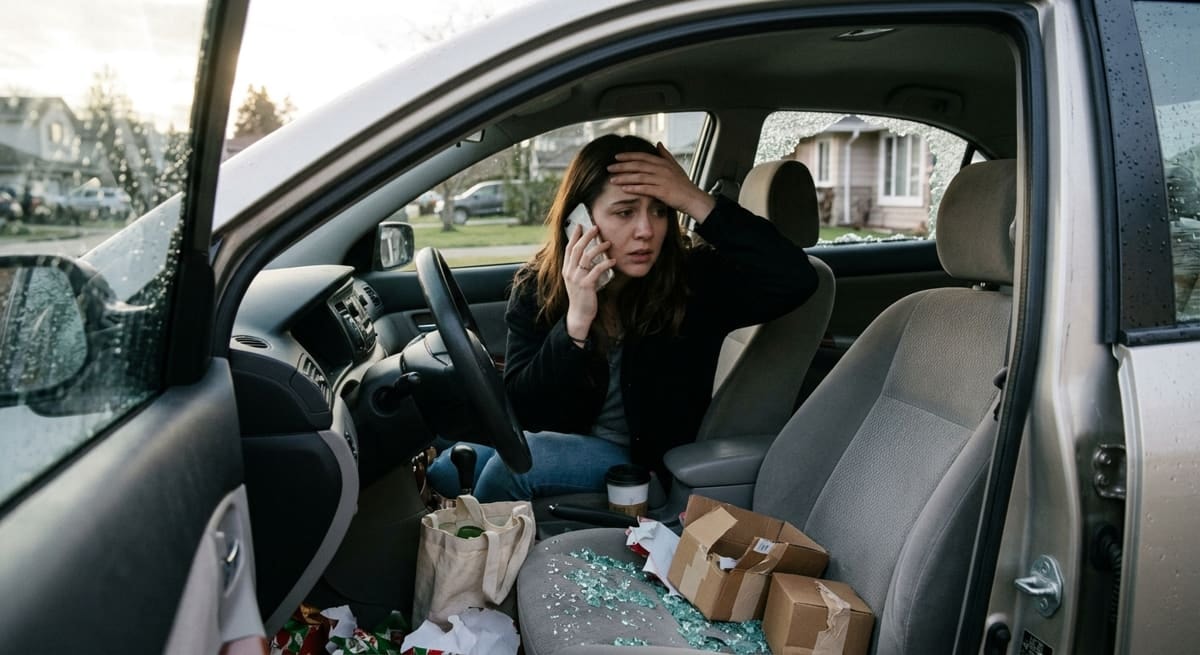
It's stressful to walk back to a smashed window. Here's a simple order to follow:
- Make sure you're safe. Don't touch anything until you've looked around, and don't confront anyone.
- File a police report and write down the report number. Your insurer will likely ask for it.
- Take photos of the damage and the scene before you clean up.
- Write down what was stolen, using your gift list or receipts.
- Call your renters insurer to start a claim.
- Call your auto insurer separately about the window, lock, or other damage to the car.
- Ask about deadlines and keep every claim number in one place.
Filing deadlines differ by insurer, so don't wait.
How to protect holiday gifts before you shop
A little prep before the shopping starts can save you a lot of trouble.
- Look up your off-premises limit on your declarations page.
- Ask about raising it, or about adding extra coverage for high-value items like jewelry or electronics.
- Keep gifts out of sight. Put bags in the trunk before you arrive, not in the parking lot where someone might be watching.
- Take gifts inside as soon as you get home, and avoid leaving them in the car overnight.
- Start your gift list now. The holiday season is when break-ins and claims tend to spike.
The bottom line
If someone steals gifts from your car, renters insurance usually helps, but only up to your off-premises limit and after your deductible. Your auto insurance handles the car damage separately. Good records make the whole process easier.
Your next step is simple: pull up your declarations page today and find three numbers. Those are your off-premises limit, your deductible, and whether you have actual cash value or replacement cost coverage.
How ChaCha Insurance can help
ChaCha Insurance is an independent insurance agency based in Chatsworth, California. Tell us what you need covered and we will compare quotes from the insurance companies we work with, free.
Coverage in this guide
Frequently asked questions
Does renters insurance cover gifts stolen from a car if the car was locked?
Often, yes. Gifts are still your property, and a locked car is the situation most policies expect. Some insurers look for signs of forced entry, so check your policy wording.
Does renters insurance cover items stolen from a car trunk?
Generally yes, since the coverage is about your belongings, not where in the car they were. Off-premises limits and your deductible still apply. Ask your insurer if they have any special rules for trunks.
Will my auto insurance pay for the stolen presents?
Usually no. Auto insurance covers the car and its built-in parts, not personal items inside it. Comprehensive coverage may pay for a broken window, but the stolen gifts typically go through renters insurance.
What if I don't have receipts for the gifts?
You can still make a claim. Card statements, order emails, store account histories, and photos can all show what you bought. Gather what you can and tell your insurer exactly what's missing.
Does filing a claim raise my renters insurance premium?
It can, depending on the insurer, your claim history, and your location. Ask before you file, especially if the loss is only slightly above your deductible. Then you can decide whether the claim is worth it.