
$500 vs $1,000 Comprehensive Deductible for a Car Parked Outside: What Should You Compare?
By ChaCha InsurancePublished 8 min read
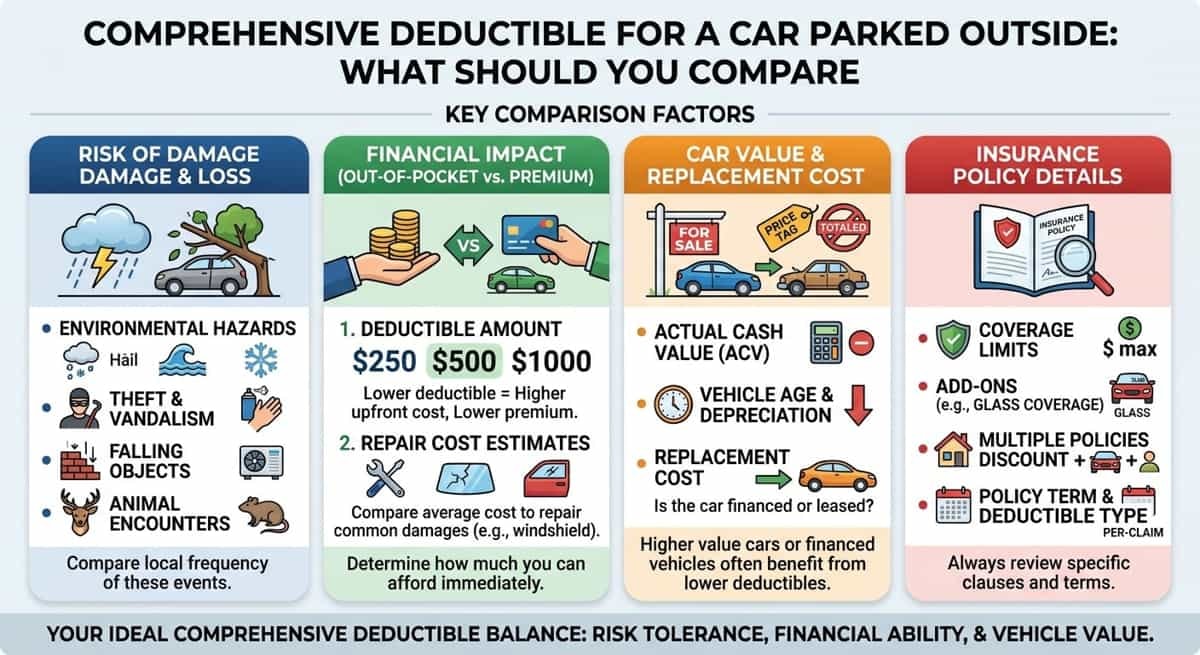
A $1,000 comprehensive deductible usually lowers your premium, but you’ll pay $500 more out of pocket if you file a covered claim. The better choice depends on three things: how much the premium drops, whether you could pay the higher amount without stress, and how much you depend on your car.
On this page (8 sections)
If your car sits in a driveway, on the street, or in an apartment lot, you’ve probably wondered whether the lower deductible is worth its price. It’s a fair question, and there isn’t one right answer for everyone. In this guide, we compare identical coverage with only one thing changed: a $500 deductible versus a $1,000 deductible on comprehensive.
One thing up front. We’re not saying a storm, a theft, or a falling branch is headed for your car. Plenty of drivers go years without a comprehensive claim.
What a comprehensive deductible is, and what it covers for a car parked outside
A deductible is the amount you pay toward a covered claim before your insurance pays the rest. If your car has $2,000 of covered damage and a $500 deductible, the insurer pays up to $1,500, subject to your policy’s limits and terms.
Comprehensive auto insurance coverage handles damage that doesn’t come from a crash. Common examples include hail, theft, vandalism, fire, and falling objects like tree limbs. It usually pays up to your car’s actual cash value, which is what the car was worth just before the damage, not what you paid for it.
A few basics worth knowing:
- Comprehensiveness is optional by law. No state requires it. But if you finance or lease your car, the lender or leasing company usually does.
- Full coverage” isn’t an official term. It usually means liability, collision, and comprehensive together, but what’s included can differ. Check your declarations page, the summary page that lists your types of insurance coverage and quotes, to see what you actually have.
- Parking outside is one of many rating factors. Some insurers consider where a car is kept, and others weigh it very little. It doesn’t automatically mean a problem or a higher price. The only way to know is to get quotes.
So when you pick a comprehensive deductible, you’re deciding how much of the “what if” you’d handle yourself and how much you’d pass to the insurer.
How the deductible trade-off works
The basic idea is simple. A higher deductible usually means a lower premium. A lower deductible usually means a higher premium. You’re trading a smaller bill now for the chance of a larger one later.
Here are four things that help make sense of it:
- You’re choosing how much risk to keep. A higher deductible means you keep more of the risk and pay less for coverage. A lower deductible means you pass more of it to the insurer and pay more for that.
- The deductible applies to each claim. If you have two separate covered claims, you pay it twice.
- Small damage may not be worth a claim. If a repair costs less than your deductible, or only slightly more, insurance won’t help much. A higher deductible makes this more likely.
- Savings vary a lot. How much you save by going from $500 to $1,000 depends on the insurer, your car, and where you live. Only your own quotes can tell you.
One more point. Your comprehensive deductible is separate from your collision deductible. You can choose different amounts for each, so don’t assume they have to match.
A worked break-even example
These premiums are invented to show how math works. They are not average prices. Get quotes for your own vehicle.
Let’s say you get two quotes for identical coverage. The only difference is the comprehensive deductible.
| $500 deductible | $1,000 deductible | |
| Hypothetical annual comprehensive premium | $180 | $140 |
| Annual premium savings | n/a | $40 |
| Extra out-of-pocket if a covered claim happens | n/a | $500 |
| Break-even | n/a | $500 ÷ $40 = 12.5 years without a claim |
The formula is simple: extra deductible ÷ annual savings = years to break even.
In this example, you’d save $40 a year with the higher deductible. If you never file a comprehensive claim, you keep that $40 every year. If you do file one, you’d pay $500 more than you would have with the lower deductible. It would take about 12.5 claim-free years of savings to cover that extra $500.
The answer changes a lot depending on how big the savings are. Here’s the same $500 gap with different premium savings:
| Annual savings | Break-even |
| $20 | 25 years |
| $40 | 12.5 years |
| $80 | 6.25 years |
What to compare when you hold everything else identical
A fair comparison means the two quotes match in every way except the deductible. Here’s a checklist to work through.
- The premium difference. Ask for both quotes at the same time, with the same coverage limits and the same other coverages. Otherwise, you’re comparing apples to oranges.
- The cash-on-hand test. Could you pay the higher deductible within a few days without borrowing or skipping other bills? If the answer is “not really,” the savings may not be worth it.
- Lender or lease rules. Some lenders and leasing companies set a maximum deductible to protect the vehicle while it is financed, and as the Consumer Financial Protection Bureau (CFPB) warns, failing to meet your lender's coverage rules can result in costly force-placed insurance. Check your agreement before you choose.
- Glass coverage. Some policies or add-ons handle windshield and window damage separately, sometimes with a lower deductible. Rules can differ by state, so ask your insurer how glass is treated on your policy.
- Special deductible rules. Some policies treat certain types of damage differently, and when you bundle home and auto insurance, certain insurers even offer a single deductible if one storm damages both your house and your car. Ask whether anything like that applies to your auto policy.
- How payouts are figured. Your deductible comes out of a payout based on actual cash value. If the damage is severe enough that the car could be declared a total loss, the deductible is subtracted from that settlement.
- Effect on future rates. Whether a comprehensive claim changes your price at renewal depends on the insurer and the state. Ask directly instead of assuming.
- Your car’s value. A $1,000 deductible means something different on a car worth $30,000 than on one worth $4,000. The older the car, the more the deductible takes up its value.
If you’re working with an agent, you can bring this list and ask them to walk through each item with you.
Risk factors for a car parked outside
A car that stays outdoors is exposed to different things than one in a garage. These might include weather, falling branches, theft or vandalism, and what’s typical in your neighborhood.
The key point is that this depends on where you live. A street with big old trees, an area known for severe storms, and a quiet cul-de-sac all carry different levels of exposure. Your state’s department of insurance and local weather services can give you a better picture of your own area than any national average.
It also helps to know you have options that have nothing to do with your deductible:
- Covered parking or a carport, when you have access to one.
- A car cover suited to your climate.
- Checking the forecast and moving the car when you can.
- An anti-theft device. The National Insurance Crime Bureau (NICB) recommends visible deterrents, immobilizers, or GPS trackers for vehicles parked outside, and some insurers offer a comprehensive discount for having one, so it’s worth asking.
And a reminder: many drivers go years without a comprehensive claim. The goal here is to help you plan for the possibility, not to predict it.
Which deductible fits which situation?
There’s no perfect answer, but these profiles can help you see where you land.
You may lean toward $500 if:
- Your emergency savings are thin.
- You depend on this car every day and have no backup.
- Your lender requires a lower deductible.
- The premium savings from going higher are small.
You may lean toward $1,000 if:
- You have a solid emergency fund.
- The premium savings are meaningful to you.
- Your car is older or worth less.
- You’re comfortable handling smaller losses yourself.
A middle path: Some insurers also offer a $750 option. If yours does, it’s worth a quote.
Here’s a simple way to think about it. If the premium savings are small and a surprise $1,000 bill would strain you, the extra $500 of risk may not be worth it. If the savings are real and you could cover the bill calmly, the higher deductible may make sense.
The right answer is personal. A licensed agent can look at your situation and your actual quotes with you.
Common mistakes when choosing a deductible
A few slip-ups are easy to avoid. Some people choose the lowest premium without checking whether they have the cash, but a cheaper policy isn’t a bargain if you can’t afford the deductible when you need it. Others compare quotes that aren’t the same, and if other coverages or limits differ, the price gap won’t tell you much about the deductible. It’s also common to assume “full coverage” covers everything, so check what’s actually listed on your policy.
Keep in mind that the deductible applies to every claim, since each covered claim has its own. Finally, don’t set the choice and forget it. As your car ages or your savings grow, the best deductible can change, and a quick review once a year is a good habit.
Bottom line and next step
Choosing between $500 and $1,000 comes down to a few honest questions. How much would you save each year? Could you pay the higher amount without stress? And how much do you rely on your car?
The easiest way to decide is to get both quotes side by side, plug the numbers into the break-even formula, and see how you feel about the result. If you’d like help, contact a licensed agent, who can walk through your options with you, with no pressure.
How ChaCha Insurance can help
ChaCha Insurance is an independent insurance agency based in Chatsworth, California. Tell us what you need covered and we will compare quotes from the insurance companies we work with, free.
Coverage in this guide