
How Do I Compare Home Insurance Quotes With Different Roof Settlement Terms?
By ChaCha InsurancePublished 10 min read
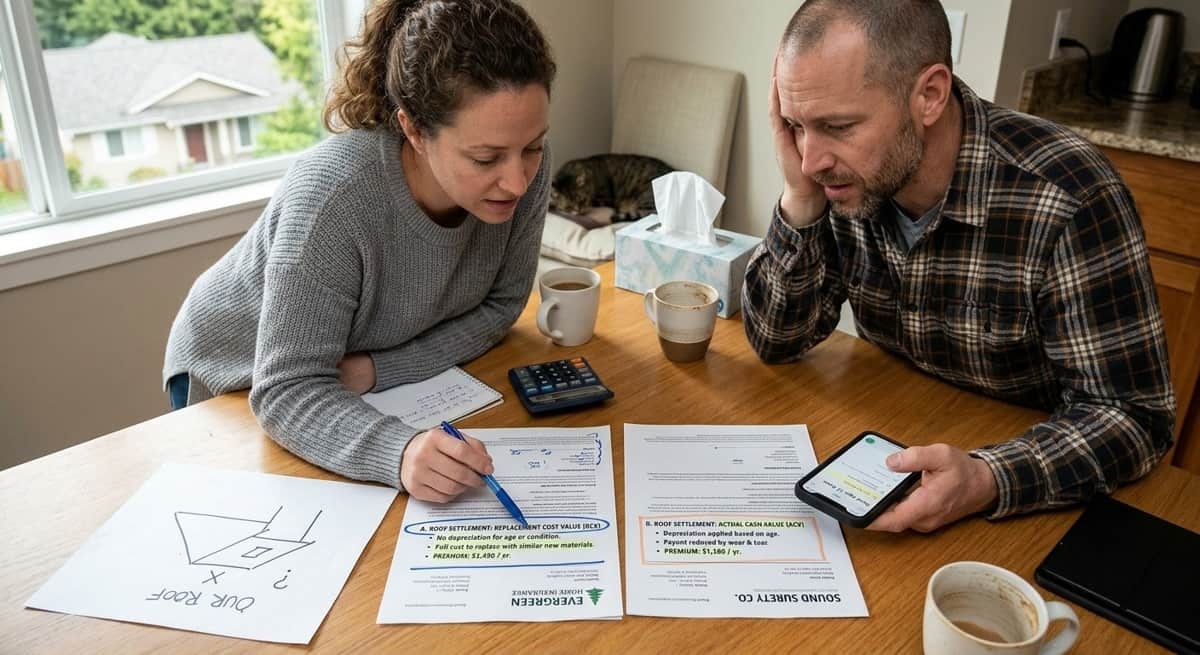
Comparing home insurance quotes isn't just about picking the one with the lowest yearly cost. You also need to know how each policy covers roof damage, especially when insurers have different settlement terms. One policy might pay the full cost of replacing your roof, while another may only cover its current value after deducting depreciation. Some insurers also use payment schedules based on your roof's age and material, which can lower your payout even more.
On this page (9 sections)
This could leave you paying thousands of dollars out of pocket after a storm or other covered damage. So, before choosing a policy, take a closer look at the roof coverage, deductibles, depreciation rules, age limits, and payout restrictions. Once you understand these details, it'll be much easier to see what each quote actually offers and choose coverage that protects your home without spending more than you need to.
Why roof terms change what a "cheaper quote" really means
Most homeowners insurance prices show the same big numbers at the top: your home's rebuilding limit (called Coverage A or dwelling coverage), your liability limit, and your premium.
That is because the roof is often treated differently from the rest of your house. One company may pay to replace it in full. Another may pay only a portion based on how old it is. The premium difference between the two can look like a nice saving, until you need to use the policy.
This matters most if your roof is around 10 years old or older, or if you are shopping at renewal because your price went up.
The four roof settlement structures in plain language
Here is what you are likely to see on a quote. The names can differ slightly from company to company, so check the wording on each one.
Replacement cost (RCV)
Replacement cost means the insurance company pays what it costs to replace the damaged roof with similar materials, minus your deductible. It does not subtract anything for age. Companies may still add conditions, such as roof age limits or rules about when you must complete the repair.
Actual cash value (ACV)
Actual cash value means the payout is the replacement cost minus depreciation. Depreciation is the amount your roof has lost in value because of age and wear. An older roof gets a smaller payment, and you cover the rest.
Roof payment schedule
A roof payment schedule pays a set percentage of the replacement cost based on your roof's age and, often, its material. The older the roof, the lower the percentage. These schedules commonly apply to wind and hail damage, while other causes of loss, such as fire, may be paid differently. Ask exactly which causes the schedule covers.
Hybrid or age-based terms
Some policies pay replacement cost while the roof is newer, then switch to ACV or a payment schedule once it passes a certain age. If a quote includes this, find the age where the change happens and put it in your calendar.
The line-by-line roof comparison sheet
Copy this table into a note or spreadsheet. Fill in one column for each quote. Where the quote does not say, write "ask," because a blank is a risk.
| Line item | What to look for | Quote A | Quote B | Quote C | Why it matters |
| Roof valuation basis | RCV, ACV, or payment schedule | RCV | ACV | Roof payment schedule | Sets the starting point for your payout |
| Perils it applies to | Wind and hail only, or all covered causes | All covered perils | All covered perils | Wind and hail | The same roof may be paid two ways |
| How roof age is measured | Install date or year the house was built | Installation date | Installation date | Installation date | A wrong date can lower your payout |
| How depreciation is figured | Roof life used, and the percent per year | Recoverable depreciation | Non-recoverable depreciation | Fixed annual reduction | Changes the ACV amount |
| Payment percentage by age | The full table, by year and material | Based on replacement cost | Based on actual cash value | 100%–50%, depending on age | Shows what you would really receive |
| Maximum payout or cap | Any dollar or percentage limit | Full covered replacement cost | Actual cash value | 50% of replacement cost maximum | Can cap the payment below the roof's cost |
| Age when terms change | The year RCV becomes ACV or a schedule | No automatic change specified | Applies from policy inception | After 10 years | Your coverage can get weaker over time |
| Cosmetic damage exclusion | Yes or no, and the exact wording | No | Yes | Yes | Dents and marks may not be paid |
| Wear and tear language | How "condition" is defined | Excluded | Excluded | Excluded | Can reduce or deny a claim |
| Matching of shingles | Whether undamaged slopes get matched | Subject to policy terms | Limited matching | No matching guarantee | Affects how much of the roof is replaced |
| Ordinance or law coverage | Whether code-required upgrades are paid | 25% of dwelling limit | 10% of dwelling limit | Not included | Repairs may cost more than the roof itself |
| Wind/hail deductible | Flat dollar or percentage | $2,500 | 2% of dwelling coverage | $5,000 | A percentage can be several thousand dollars |
| Separate hurricane deductible | Which storms and which areas | 2% | 2% | 5% | May be higher than your regular deductible |
| Deductible order | Taken before or after the schedule percentage | Deducted from covered loss | Deducted from ACV payment | Deducted according to policy wording | Changes the final check |
| Roof age or condition limits | Maximum age, inspection, photos | Inspection required for older roofs | 15-year condition review | 20-year maximum for full coverage | You may be dropped or surcharged |
| Annual premium | The price for the full year | $2,400 | $1,950 | $1,650 | Compare it last |
| Premium difference vs. roof gap | Savings per year vs. payout lost | Baseline | Saves $450/year | Saves $750/year | Shows if the saving is worth it |
The same roof under three quotes
The numbers below are a hypothetical illustration. They are not real quotes, and your policy may work differently. Say your roof is 15 years old and would cost $20,000 to replace. Your home's Coverage A is $400,000.
| Quote A | Quote B | Quote C | |
| Roof terms | Replacement cost | Payment schedule (40% at age 15) | ACV (roof 60% depreciated) |
| Deductible | $2,500 flat | $2,500 flat | 1% of $400,000 = $4,000 |
| Roof value before deductible | $20,000 | $20,000 x 40% = $8,000 | $20,000 x 40% = $8,000 |
| Payout after deductible | $17,500 | $5,500 | $4,000 |
| Annual premium | $2,400 | $2,000 | $1,850 |
| You pay out of pocket | $2,500 | $14,500 | $16,000 |
Quote B saves you $400 a year. If the roof is damaged, it pays $12,000 less than Quote A. At that rate it would take 30 years of savings to make up the difference. Quote C saves $550 a year but pays $13,500 less, which is about 24 years of savings.
A wrinkle on Quote B: if the policy takes the deductible first and applies the 40% afterward, the math becomes ($20,000 - $2,500) x 40% = $7,000. Same quote, a $1,500 difference, just from the order. That is why the sheet has a row for it.
The takeaway is simple. A lower premium can be a good trade for some homeowners, but only if you can afford the gap on the day you need the roof replaced.
Exclusions and fine print that quietly change the payout
These terms show up in the small print. You do not need to memorize them. Just make sure you know where each quote stands.
Cosmetic damage exclusion. This removes coverage for damage that changes how the roof looks but not how it works, such as dents in metal. Ask your agent: "Does this policy pay for hail marks that do not cause leaks?"
Wear and tear and condition language. Policies generally do not pay for ordinary aging. Some wording leaves room to argue that hail damage was just old age. Ask: "How does the policy define wear and tear on the roof?"
Matching. If only one side of your roof is damaged, will the company pay to replace shingles on the undamaged slopes so they look alike? Some do and some do not. Ask: "Is matching covered, and under what conditions?"
Ordinance or law coverage. When a roof is replaced, local building codes may require extra work, like new drip edge or decking repairs. This coverage helps pay for those required upgrades. Ask: "Does ordinance or law coverage apply to my roof, and what is the limit?"
How the deductible interacts with roof terms
Many policies have a separate wind and hail deductible, and it is often a percentage of your Coverage A, not a fixed dollar amount. On a $400,000 home, 1% is $4,000 and 2% is $8,000. Dollar deductibles like $1,000 or $2,500 look very different from that.
Two things to confirm in writing:
- The order of operations. As the example showed, subtracting the deductible before or after the schedule percentage can change your check. The answer depends on the form, so ask for it in writing.
- Which storms trigger which deductible. Some policies use a higher hurricane or named-storm deductible. Ask when it applies and what it costs in dollars on your home.
A higher deductible can lower your premium, and if a single hailstorm damages both your roof and your car, bundling home and auto insurance may qualify you for a single shared deductible with some insurers just to make sure you could comfortably pay your deductible tomorrow.
How to get true apples-to-apples quotes
If you want to compare home insurance quotes fairly, give every company the same facts and ask for the same documents. Here is a simple process:
- Give each company the same roof details: age, material, and install date. If you have the receipt or permit, keep it handy.
- Ask for the roof endorsement and loss settlement wording, not just the quote summary page.
- Request the payment schedule table in writing, if there is one.
- Ask about exclusions and the deductible method, especially cosmetic damage, matching, and the order of the deductible.
- Fill in the comparison sheet and compare the quotes line by line.
When the cheaper quote is probably the wrong one
There is no single right answer for everyone. These questions help you decide:
- How old is the roof, and how long will you stay? A roof near the end of its life pays less under ACV or a schedule, so the gap may show up soon.
- Could you cover the gap? If a $15,000 surprise would be hard, replacement cost may be worth the higher premium.
- Does your mortgage lender have rules? Some require certain coverage, and if your home and car are currently bundled, check how unbundling affects your total price and escrow before switching one policy while keeping the other.
- Is the saving real? Divide the roof payout gap by the yearly premium saving (the same break-even math used when comparing a $500 vs. $1,000 deductible). If it would take decades to break even, the cheaper quote is carrying more risk than it first appears.
In fairness, a payment schedule or ACV option can be a sensible choice. Older roofs can be hard to insure, and these options may keep your premium manageable or help you get covered at all. They are a trade, and the sheet helps you see exactly what you are trading.
Your next step
The cheapest quote is not always the lowest-cost choice once a storm hits. Fill in the comparison sheet, read the roof wording on each quote, and do the break-even math before you sign.
If you want help, working with an independent insurance agent vs. a captive agent lets you compare roof endorsements across multiple carriers, reach out to compare insurance quotes and have a licensed agent walk through the policy forms with you.
How ChaCha Insurance can help
ChaCha Insurance is an independent insurance agency based in Chatsworth, California. Tell us what you need covered and we will compare quotes from the insurance companies we work with, free.
Coverage in this guide
Frequently asked questions
Is a roof payment schedule worse than ACV?
Not always. Both pay less as the roof ages. A schedule shows the percentage up front, which makes it easier to predict. ACV depends on how the company calculates depreciation at the time of the claim. Compare actual numbers, not the labels.
How is my roof's age counted?
It depends on the company. Some use the year the roof was installed, others use the year the house was built or what an inspection suggests. Give each company the same install date, and ask in writing how they will count it.
Does a payment schedule apply to damage that is not weather-related?
Often it applies only to wind and hail, and other causes such as fire may be paid under different terms. Wording varies, so ask which causes of loss the schedule covers and read the endorsement.
Can I switch from ACV to replacement cost on an older roof?
Sometimes, but many companies limit replacement cost on older roofs or ask for an inspection or photos. Replacing the roof often opens up better terms. Ask your agent what the company requires and how it affects the price.
Who do I contact if I think a roof claim was underpaid?
Start with your insurance company and ask for a written explanation of how they calculated the payment. If you still disagree, contact your state's department of insurance. It can explain your options and take complaints.