
HMO vs EPO When Your Specialist Is Outside the Network: What Should You Check?
By ChaCha InsurancePublished 11 min read
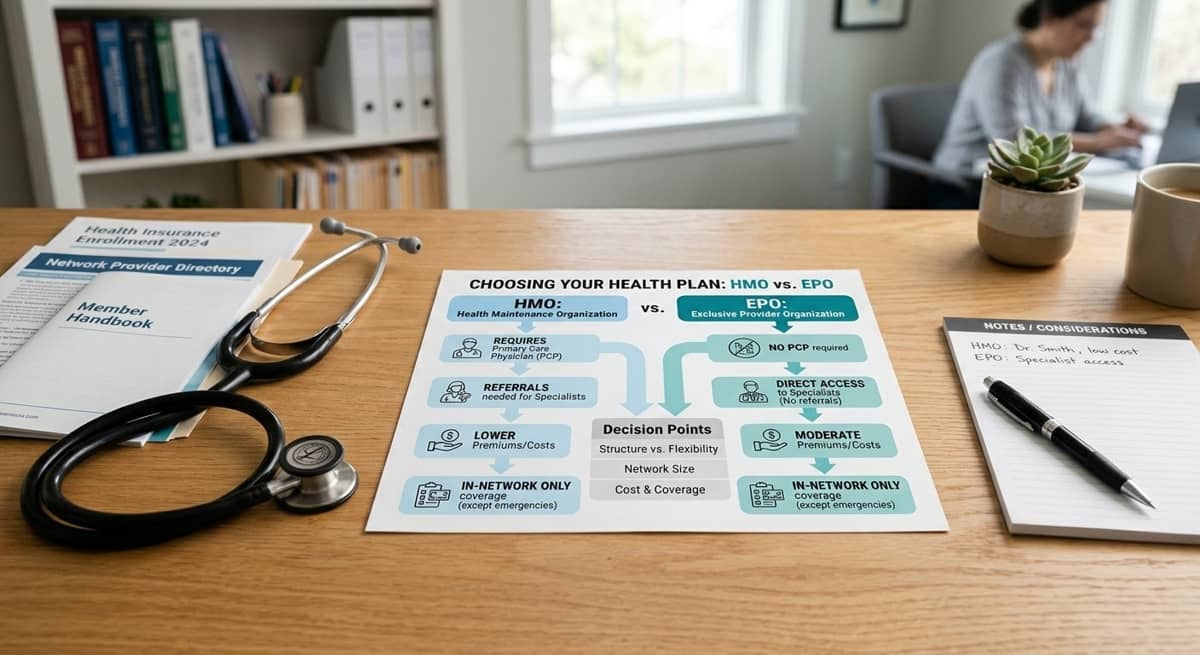
Choosing between an HMO and an EPO health insurance plan matters, especially if the specialist you want to see isn't in your plan's network. Both plans generally expect you to visit in-network doctors, but they don't follow exactly the same rules for referrals, specialist visits, or out-of-network care. With an HMO, you'll usually need to pick a primary care doctor and get a referral before seeing a specialist.
On this page (8 sections)
An EPO is a bit more flexible. You can typically visit in-network specialists without a referral, but it usually won't cover out-of-network care unless it's an emergency. So, what if the specialist you trust isn't covered by your plan?
Before making a choice, check which doctors are in the network, whether out-of-network care is covered, referral and prior authorization rules, and how much you'll have to pay yourself. Knowing these details can help you avoid surprise medical bills and find a health insurance plan that works for your healthcare needs.
How HMO and EPO Network Rules Differ
Both plans are built around a network: a group of doctors, hospitals and labs that have agreements with your insurer. Stay inside it, and your plan pays its share. Step outside it, and you may owe the whole bill.
A few quick definitions:
- In-network: providers that have a contract with your plan.
- Out-of-network: providers that do not. They can charge you more, and your plan may pay nothing.
- Primary care provider (PCP): the doctor who manages your overall care.
- Balance billing: when an out-of-network provider bills you for the gap between what they charge and what your plan pays.
For both HMOs and EPOs, emergencies are the main exception to the network rule.
Where they differ: referrals and your PCP
The biggest everyday difference is how you get to a specialist.
With an HMO, you usually choose a PCP and get a referral from them before seeing a specialist. That referral still has to point to a specialist in the plan's network. The one common exception is when the plan has no suitable network specialist and agrees to make an exception.
With an EPO, you can usually see an in-network specialist without a referral. EPO rules vary by insurer, so check your own plan.
In neither plan can you skip the network just by choosing to.
| HMO | EPO | |
| Network required for non-emergency care | Yes | Yes |
| Referral to see a specialist | Usually yes | Usually no |
| Primary care provider required | Usually yes | Varies by plan |
| Out-of-network coverage | Generally emergencies only | Generally emergencies only |
| Exception route if no network specialist fits | Possible, plan must approve | Possible, plan must approve |
Is Your Specialist Really Out of Network? Check This First
Before you worry about exceptions, make sure the doctor is truly outside your network. Mistakes here are common, and they can work in either direction.
Check the network name, not just the insurer. One insurance company can run several networks. A doctor who "takes Blue Cross" or "takes Aetna" may not be in the network that your specific plan uses. Look at your insurance card or plan summary for the exact network name.
Check the doctor, the facility and the billing group. The specialist may be in-network while the surgery center, lab, anesthesiologist or imaging center is not. Each one can bill separately.
Be careful with online directories. They are sometimes out of date. Under federal rules, if an insurer wrongly tells you a provider is in network, the insurer may have to cover the care at in-network rates. Rules can differ by plan and state, so do not count on it, but do save screenshots and write down who told you what.
Confirm status for your appointment date. Networks change. A doctor listed today may leave next month, and the reverse can happen too.
Look at alternatives first. Ask whether another in-network specialist could treat your condition, or whether a telehealth visit with an in-network provider could be a first step. If the answer is no, that matters for the exception request later.
Emergency Exceptions: What Is and Isn't Covered
If you have a real emergency, go to the nearest emergency room. HMO and EPO plans are expected to cover emergency care even when the hospital or doctor is out of network.
Federal surprise-billing protections, which began in 2022, cover emergency care, certain out-of-network care at in-network facilities, and air ambulance services. Your plan and the law define "emergency," and that is not always the same as how a visit felt to you. Urgent care is not automatically treated as an emergency, so ask your plan how it handles urgent care visits.
After you are stabilized
This is where things get less clear. Once the emergency is over, the rules for the care that follows can change.
In general, the idea is that you can be moved to an in-network facility once it is safe. Follow-up visits with a specialist usually go back to normal network rules. That means a follow-up with the out-of-network surgeon who treated you in the ER may not be covered the same way.
If you are asked to sign anything about ongoing care at an out-of-network facility, pause and call your insurer first.
An out-of-network provider at an in-network hospital
Sometimes you choose an in-network hospital, and one of the people treating you, such as an anesthesiologist or radiologist, is out of network. Federal surprise-billing rules are designed to protect you from extra bills in many of these cases.
You may be handed a form asking you to give up those protections. You are not required to sign it. These protections generally do not apply to every type of plan, and short-term plans are often excluded, so check how they apply to yours.
Authorization Pathways When No In-Network Specialist Fits
Now for the part most guides skip. People often use three terms as if they mean the same thing. They do not, and mixing them up is a common reason claims get denied.
Referral vs prior authorization vs network gap exception
| What it is | Who usually starts it | What it does | |
| Referral | Your PCP recommends you see a specialist | Your PCP | Lets you see an in-network specialist on an HMO |
| Prior authorization | Your plan approves a specific service before you get it | Usually the doctor's office | Confirms the service is covered and medically needed |
| Network gap exception | A formal request for the plan to cover an out-of-network provider at the in-network rate | You, your PCP or the specialist's office | Can make an out-of-network visit cost the same as in-network |
Here is the key point. Getting one approved does not mean the others are approved. One large insurer's guidance says a prior authorization approval does not mean you can get care out of the network, and that a gap exception request is made separately. The same guidance says the request must be made before the care happens.
The steps and forms also differ by insurer. Some require a prior authorization case to be opened before a gap exception request can be filed. Always ask your plan how its process works.
The HMO pathway
A common order of steps looks like this:
- Ask your PCP for a referral and explain why you need this specialist.
- Ask whether the service needs prior authorization.
- If your plan has no suitable in-network specialist, ask for a network gap exception.
Gap exceptions are usually decided case by case, and you should ask before you get care. If you go first and ask later, you may be stuck with higher costs.
Plans often look at things like whether there is an in-network specialist for your condition, and whether one is available within a reasonable distance or time. The exact standards depend on your plan and state, so ask for the specific rule your plan uses.
The EPO pathway
No referral does not mean no approval. An EPO may still require prior authorization for certain services.
The gap exception idea works the same way. You, or the specialist's office, ask the insurer to cover the out-of-network provider at the in-network rate. If your EPO has no out-of-network benefits at all, an approved exception is how you get coverage. Without one, you would likely be responsible for the full cost.
If your specialist leaves the network during treatment
Sometimes a doctor leaves the network while you are in the middle of care. Federal rules give some patients who are in ongoing treatment a temporary period of continued coverage when a provider's contract ends. Ask your plan whether you qualify and how long the transition period lasts.
Verification Call Checklist
A good phone call can save you thousands of dollars. Use this list so you do not forget anything.
Before you call
Have this information in front of you:
- Your member ID, plan name and plan type (HMO or EPO)
- The specialist's full name, address and facility
- The specialist's NPI number and tax ID (their office can give you these)
- The service or procedure name, if you know it, and your diagnosis
Call the member services number on the back of your insurance card.
Questions for your insurer
- What is my plan type and the exact name of my network?
- Is this doctor, and this facility, in-network for my plan on my appointment date?
- Do I need a referral? How long is it valid, and for how many visits?
- Does this service need prior authorization? Who submits it?
- Do you have an in-network specialist for my condition? What standard do you use for distance or wait time?
- If not, how do I ask for a network gap exception? Who files it, what documents are needed, and how long does a decision take?
- If it is approved, what will I pay, and does it count toward my deductible and out-of-pocket maximum?
- If it is denied, how do I appeal, and what is the deadline?
- Can you confirm all of this in writing?
Questions for the specialist's office
- Are you in-network for my exact plan and network name?
- Who bills for the visit, and where will I be seen?
- Are anesthesia, lab, pathology or imaging billed separately? Are those providers in-network?
- Will your office send the authorization or exception paperwork?
- If I go ahead without coverage, can you give me a written cost estimate?
Write everything down
For every call, note the date, time, the representative's name and the call reference number. Write down exactly what they promised. Afterward, send a short message through your insurer's portal or by email that sums up the call. A paper trail is your best protection if there is a dispute later.
If the Answer Is No: Your Options
A "no" is not always the end. Here is what you can try:
- Appeal. Ask how to file an internal appeal. If that fails, you may be able to ask for an outside review. HealthCare.gov and your state's insurance department explain the process.
- Ask for a peer-to-peer review. This lets the specialist talk directly with the plan's medical director about why the care is needed.
- Look at other in-network options. That could mean another specialist, a different location or a telehealth visit.
- Get help. Your state department of insurance, or your employer's benefits team if you have job-based coverage, can often point you in the right direction.
- Check your plan options. Whether you can change plans right now depends on the type of coverage you have and your circumstances. Ask your plan administrator, the official marketplace, or an independent insurance solution who can check provider networks across multiple insurers for the current rules rather than assuming.
If you decide to pay for care yourself, get the full cost in writing first, and ask what is and is not included.
The Bottom Line
When your specialist is outside the network, take it in three steps. Confirm the doctor really is out of network. Check whether an emergency or surprise-billing protection applies. Then ask your plan about an exception before you book.
Most of the pain in these situations comes from assuming instead of asking. A short, well-documented phone call can make the difference, and if you want help checking which plans include your doctors before you enroll, contact our insurance advisers to compare your options side by side.
How ChaCha Insurance can help
ChaCha Insurance is an independent insurance agency based in Chatsworth, California. Tell us what you need covered and we will compare quotes from the insurance companies we work with, free.
Coverage in this guide
Frequently Asked Questions
Can an EPO cover an out-of-network specialist?
Generally no, except in an emergency. If no in-network specialist fits your needs, you can ask the plan for a network gap exception. It is up to the plan to approve it, so ask before you get care.
Does an HMO referral make an out-of-network specialist covered?
Not by itself. An HMO referral normally has to point to a network specialist. A referral to an outside doctor usually needs the plan's separate approval.
Does a prior authorization approval mean I can see an out-of-network doctor?
No. Prior authorization approves a service. It does not automatically approve an out-of-network provider. Ask whether a gap exception is also needed.
What if the specialist told me they were in-network and they weren't?
Call your insurer right away and keep records of what you were told, including screenshots of any directory listing. Federal rules may protect you in some cases, and you can appeal if a claim is denied.